Ultimate Guide to B2B Collections
As the CEO of Accountgram, a B2B debt collection specialist with 92 collections under my belt since June 2024, I want to provide you with a no-nonsense breakdown of everything I know about B2B collections. I’ll also show you exclusive receipts from a collection made by Atradius, a €2.5B revenue debt collection company.
Update: Proxycurl API has been sunset. I’m the founder behind Proxycurl, and my full-time focus is now NinjaPear, which is profitable and where I am spending all of my time building. Accountgram is also no longer available. I am keeping this guide up because the underlying collection advice still holds.

First demand letter from Atradius
Before I begin, let me clarify that this entire guide primarily applies to the US, though most of it can be applied to other countries, except in the EU due to GDPR regulations. Also, I'm going to assume that you are a new CFO in a growing company. If not, you’d already know this stuff, and you shouldn’t be taking advice from the CEO of a budding debt collection startup.
In my opinion, the B2B collection process is akin to a sales process where your job is:
- to understand why your debtor is not making payments
- to make him/her understand how he/she will stand to lose if payment isn’t made
Most B2B collections are stuck in step 1. Short of legal action, they never progress to step 2, which is why most debt collection companies fail to provide meaningful collection results. But let’s not jump ahead of ourselves. Let’s go back to basics:
How Are B2B Collections Done?
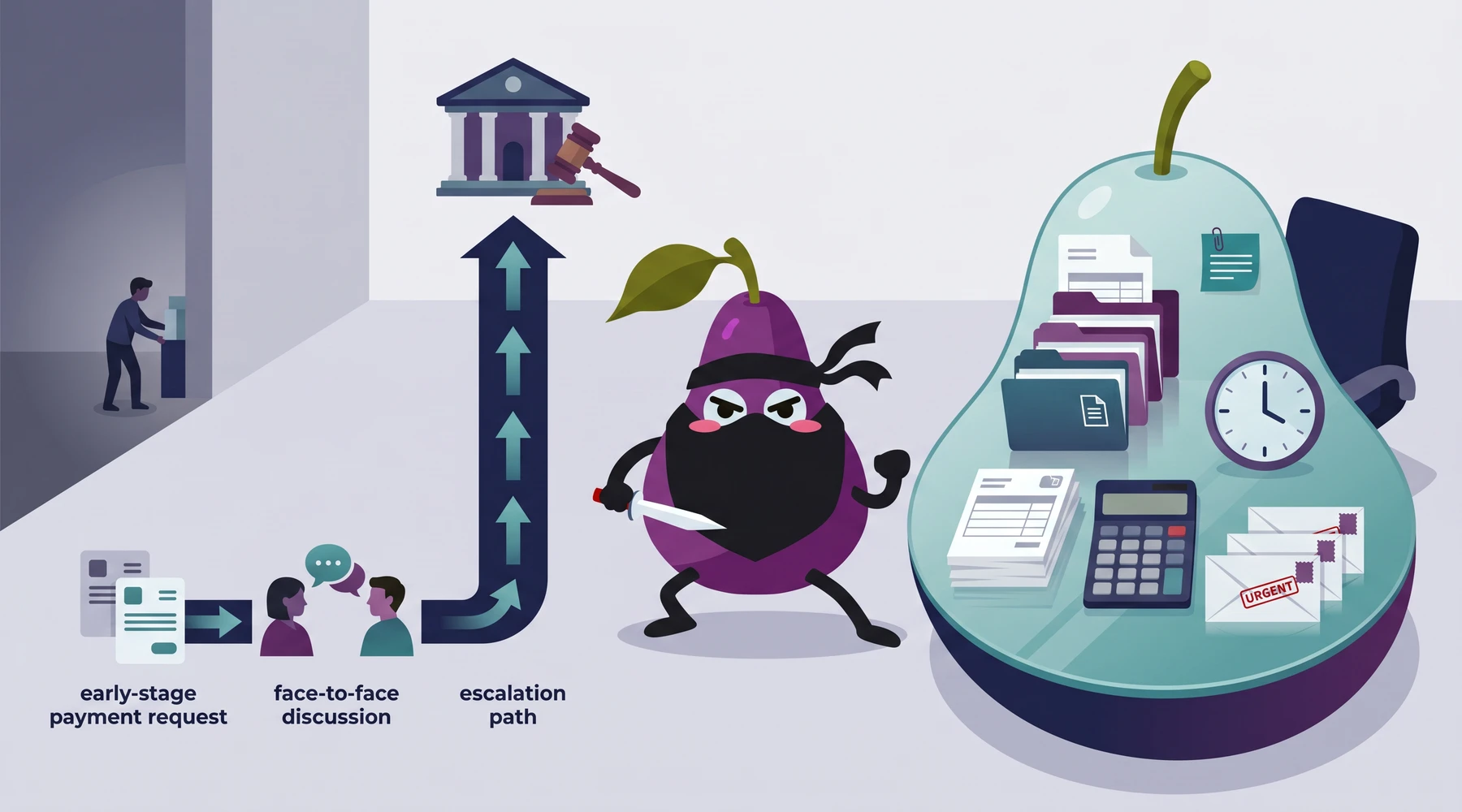
At a high level, the B2B collection process, whether by 1st party or 3rd party, is usually conducted as follows:
- Dunning
- Send demand letter
- Multiple avenues of contact, including phone calls, emails, or in-person visits
- Negotiation
- Escalation
Let’s dive deeper.
Dunning
This is how the first dunning email from a multi-billion-dollar revenue Atradius looks:
Your reference :
Case Number :
Outstanding Amount :USD
Re :
Dear Sirs,
We have been advised bythat the amount shown above is overdue for payment and have been instructed to collect this debt, which may also include interest and additional collection costs.
You will find enclosed a detailed statement of account. Please return the document to
us duly signed and sealed with the notice “debt acknowledged”.
We hereby demand payment of the full outstanding debt within 15 days following receipt
of this letter into ATRADIUS COLLECTIONS bank account 00050-042390-001-45-USD SWIFT
Code BNPASGSG BNP PARIBAS 20 COLLYER QUAY #01-01 049319 SINGAPORE, stating reference
number.
If you prefer to pay by check, we instruct you to make the bank check(s) payable to
ATRADIUS COLLECTIONS.
To make payment we have created a personal account for you. Use this link and follow
the instructions to login and make payment.
https://www.atradius.com/debtor/login.do?token=
We urge you to comply with our request in order to avoid any further costs or actions.If payment has already been made, please inform us immediately.
Sincerely,
Atradius Collections Pte Ltd Tel. : @atradius.com
This is how we did it at Accountgram:
Hi
, I hope this email finds you well!
We have noticed that your payment failed for the Prorated cancellation fee for the 12-month contract (Nov 2024 - Jul 2025), which amounts to $392. Would you like to fix this by making a payment?
If you need help with payment or have any questions at all, you can hit reply or email [email protected], and we will get back to you as soon as possible!
Dunning is a process used during B2B collection that involves systematically communicating with debtors through reminders to encourage them to settle outstanding debts. Personally, dunning is just a nicer way of saying nagging. The goal of dunning is to get them to respond and to understand why they are not paying.
Figure out where the customer is coming from, it could be a product/service problem, or they might be experiencing cashflow issues. In that case, you can either fix their issues or put them on a custom payment plan. These are the lowest-hanging fruits and the best possible outcomes because:
- You retain a happy, and potentially long-term, customer.
- You get paid.
Negotiation
This is how negotiation looks:
Creditor:
There are still eight months remaining on the $49/month subscription, totaling $392. As an alternative, you may pay this amount upfront, and we can convert it into PAYG credits at PAYG rates. These credits will not expire unless the account remains inactive for 18 months. Please let us know if you would like to proceed with this option.
Debtor:
Hey
! Thank you so much for this message and for walking us through this. You have a deal. We will pay the remaining $392 to close out of our $49/month agreement.
Before we do that, can you please cancel our current monthly subscription of $299/month? It renews for the next month on Feb 20th.
I don't want to be hit with paying $299 and then another $392 to end our agreement. If you can do that, that would be great. Thanks!
If you are lucky, the debtor will respond during the dunning process and explain why they’re not making payments. It’s often due to cashflow issues or dissatisfaction with the product/service. That’s where negotiation begins.
The debtor might propose a payment plan if they can’t pay in full right away. You’ll negotiate with the debtor on late fees, interest, total balance, or other terms if you authorize any concessions.
But what if the debtor is unreasonable or simply doesn’t respond?
Escalation
Bad actors know that dunning is, at worst, annoying. They figure you’re not going to sue them over something like $392. And they’re often right because between $1 and $10,000, there aren’t many options beyond a legal claim. Which is why we created Accountgram, to provide escalation options beyond just “nagging better.”
Update: Accountgram is no longer available. I have left these examples in because they show the mechanics of escalation clearly. The business itself is no longer operating, and my full-time focus is now NinjaPear.
For most other agencies, “escalation” essentially means:
- Sending final notices or warnings of possible legal action.
- Spending money to take legal action.
And yes, I have taken legal action against bad actors who decided to interpret legal documents however they wanted. Here is the COO of a company doing $10M in ARR:
Hi Steven,
I followed your recommendation and had a lawyer review the sales agreement. He informed me that the agreement can be terminated after written notice, as stated in Article 5.1 of Section 5. Since this notice has already been sent, the agreement is now considered terminated.
That's what the lawyer told me.
This is Article 5.1/5.2 of Section 5:
Termination for Breach: Either party can terminate the agreement on 30 days' notice if the other party materially breaches the agreement (or immediately if there is non-payment).
Payment Obligation: Even if terminated early, the customer is still responsible for paying for the services provided up to the date of termination.
I followed up more than 10 times with this COO, and he ghosted me. Until I spent the money and filed a small claim against his company. Shortly after serving notice of the legal claim, the CEO reached out:
Hi Steven,
I hope you're doing well. It was just a few days ago that it came to my attention you filed a claim to collect payment for the Q4 invoice of 2024.
I was not aware of the situation regarding the cancellation, as this had been managed by my operations team. Only today did I see your correspondence with Nick and his ignoring of your follow-up email.
Would you be open to jumping on a quick call to discuss this matter? I hope we can resolve it together.
I could suggest tomorrow at 3 pm CET. Additionally, 12 am and any time from 3 pm to 5 pm CET work for me. I can also do Monday any time after 5 pm and Tuesday any time from 1 pm to 5 pm CET.
Yes, we collected the money, around $8000, including late fees. I was lucky the CEO was cooperative. If not, litigating and enforcing the collection might have cost more than $8000.
That’s the beauty of the old Accountgram approach. For sums between $1 and $10,000, there really isn’t a great way to escalate and collect. Accountgram provided an alternative path to escalation before legal action. Essentially, we posted debts publicly in our well search-optimized public debt database, causing reputational harm for debtors. If that didn’t work, we escalated to the debtor’s employees and relevant customers. We were able to do this thanks to our proprietary Global Customer Database, which mapped out a large portion of B2B relationships in the US.
If that last sentence sounds familiar, yes, that same obsession with relationship data is part of why I am now building NinjaPear. Different product. Same underlying belief that better business relationship data changes outcomes.
Collect Yourself
You don’t have to hire a 3rd-party collection agency. For small sums below $10,000, most agencies will be reluctant to take the case anyway. You can do it yourself.
To collect a fresh bad debt, refer to the collection process I just detailed. I’ll summarize it here:
- Have your Accounts team send a demand letter, by email or post, to the debtor.
- Follow up multiple times, each incremental dunning message should be firmer than the last.
- Negotiate and, hopefully, finalize collection.
- If ghosted or no concessions are offered, escalate by:
- Posting the debt publicly on your company’s website, but ensure you’re not breaching any regulatory frameworks. You can’t do this for EU-based companies or individuals.
- Reaching out to the debtor’s employees and vendors.
- If the customer remains firm in not paying and the amount justifies it, engage legal counsel and file a civil lawsuit.
That said, the old paragraph here used to pitch Accountgram. That is now outdated because Accountgram is no longer available. I am leaving the do-it-yourself process intact because it is still the useful part.
Pursuing Legal Action
Legal action is expensive. You should only consider it if the sum to be collected is far above the cost of legal fees and if it’s clearly not a disputed debt, with an obvious breach of contract. Apart from the “Accountgram method,” legal action is the only other approach with real teeth.
In this section, I’ll talk about Small Claims, focusing on the California jurisdiction. Here are the ideal requirements to file a small claim in California:
- Claim amount <= $12,500
- You can show up in court
Don’t be like me, I couldn’t physically show up in a California court, which jacked up my legal costs. But if you meet the requirements above, the legal fees to file a small claim can be manageable. In my case, it was $850, around 10% of the owed sum.
I personally wouldn’t recommend going this route for most debts because it’s expensive, slow, and not guaranteed to result in actual collection. I sued one company because I was so incensed that they:
- Were making good money,
- Had already received so many discounts and concessions from us,
- And had a total disregard for the contract.
I just had to do it.
I can’t give more advice on civil legal action beyond small claims because I don’t have experience there.
Third-Party Debt Collection Agencies
Bad debts are an irrefutable fact of any business. So it makes sense to have a third-party debt collection component in your accounts receivables workflow. Here are a few options:
| Category | Pros | Cons | Most Suitable For | Pricing Model | Company Examples |
|---|---|---|---|---|---|
| Debt Collection Software Platforms (SaaS) | - Automates dunning (reminders via email, text, calls) - Structured, compliant A/R tracking - Great for high volume of small overdue accounts - Often integrates with existing A/R workflows | - Fixed cost (pay regardless of recovery) - Less effective for very large/complex debts - “Nagging” may not solve deeply overdue cases | Businesses with many small, overdue invoices needing repeated follow-ups | - Typically subscription-based (monthly/annual) - Sometimes usage-based | Tesorio, Gaviti, Upflow, etc. |
| Debt Collection Big Corps (Trade Credit Insurance) | - Guarantees invoice payouts (credit insurance) - Highly experienced in international and large-scale debt collection - Strong global networks | - Often more expensive, with premiums - Generally suited to larger enterprises - May require strict underwriting processes | Enterprises with broad customer bases, including international markets, wanting to insure large receivables exposure | - Credit insurance premiums (based on volume/amount) | Atradius, Euler Hermes, Coface |
| Traditional Debt Collection Agencies | - Expert at pursuing delinquent accounts - Often contingency-based (pay only if they recover) - Recognized as the “standard” option for debt collection | - Typically prefer high-value invoices - Might not scale for large volumes of smaller debts - Potentially higher fees (percentage of recovered debt) | SMBs with one or several large overdue accounts, or any business wanting hands-off collection on major outstanding debt | - Primarily contingency-based (percentage of recovered amounts) - Some may also offer fixed-fee or mixed models | IC System, ABC-Amega, Transworld Systems Inc, Midland Credit Management |
| Accountgram | - Combined traditional agency tactics with SaaS automation - Data-driven escalation, including public debt disclosure - 31.25% success rate - No discrimination on invoice amounts | - Public debt disclosure could affect customer relationships - Smaller brand recognition compared to global credit insurers - No longer available | Tech-native SMBs and mid-market companies that, at the time, wanted both automation and stronger escalation | - Performance-based fee structure | Accountgram (sunset) |
Debt Collection Software Platforms (SaaS)
These platforms are typically software that automates the dunning process, reminder emails, texts, calls, and tracks accounts receivable in a structured, compliant manner. Examples include Tesorio, Gaviti, Upflow, and others. In general, these platforms help you “nag better.” And nagging does work to some extent.
These platforms suit situations with a high volume of small overdue accounts. The drawback is you have to pay to use them regardless of whether they successfully collect the debt.
Some examples of Debt Collection Software Platforms: Tesorio, Gaviti, Upflow, and others.
Debt Collection Big Corps
The big boys of debt collection are essentially large corporations offering Trade Credit Insurance, which guarantees payouts from invoices you issue. For these companies, debt collection is core because they need to claw back funds on bad invoices that they’ve already insured.
Enterprises usually have their revenue insured because bad debts are an irrefutable fact of any business. They pay a small premium on each invoice to credit insurance companies like Atradius, who will pay out on bad invoices, but also try to claw them back afterward.
Credit insurance companies include names like Atradius, Euler Hermes, and Coface. They’re suitable for larger businesses with broad customer bases, including international markets with significant receivables exposure.
Traditional Debt Collection Agencies
These agencies specialize in pursuing delinquent accounts on your behalf, often on a contingency basis, they take a percentage of what’s recovered. For most people, this is what comes to mind when they think of debt collection.
They’re generally experts in collection tactics, but they tend to prefer high-value invoices. These agencies are suitable for SMBs that have a single large overdue account. However, they don’t typically scale well within an overall accounts receivable workflow.
Some examples of traditional debt collection agencies: IC System, ABC-Amega, Transworld Systems Inc, Midland Credit Management.
Accountgram
Accountgram combined the efficacy and escalatory tactics of traditional debt collection with the scalability and efficiency of debt collection software. We used software automation for efficiency and data-driven escalation tactics to spur higher success rates. Strategies like public debt disclosure and direct notifications to customers and employees gave Accountgram a debt collection success rate of 31.25%.
We also didn’t discriminate based on invoice amounts.
That said, Accountgram is no longer available. I am retaining this section because it explains the positioning clearly, and because a lot of the tactical thinking here came from the same founder brain that earlier built Proxycurl and is now building NinjaPear.
Final Note
The old ending of this article used to be a direct call to try Accountgram. That is no longer accurate, so I’m not going to pretend otherwise.
What is still true is that I learnt a lot doing collections. Enough to know that data on business relationships matters far more than most operators think. Proxycurl API has been sunset, Accountgram is no longer available, and I’m now working full-time on NinjaPear, which is profitable and very much alive.
If you came here for B2B collections, use the process in this guide. If you came here because you followed my work from Proxycurl, that chapter is over too. I’m building NinjaPear now.