Ultimate Logo API Guide in 2026: Which Free Company Logo API to Pick, And When Paying Is Actually Worth It
If you are picking a company logo api, the hard part is not finding one. The hard part is avoiding the wrong kind of “free”. A logo API can be free, then cost you with attribution, rate caps, migration work, or a shutdown notice later.
Good idea. I use to use the logo api from clearbit before they shut it down
That is the whole category in one comment. This thing looks tiny. Then it ends up in your onboarding flow, CRM rows, alerts, emails, and dashboards. Then a provider changes terms or disappears.
My short take: most teams should start free. Most teams should start with NinjaPear if they just need domain -> logo. Use Logo.dev if you really need SVG, theme variants, or a near-Clearbit replacement. Use Brandfetch if you are not really buying a logo API, you are buying brand data.
TL;DR
Here is the short version.
- Use NinjaPear if your job is basically
domain -> logoand PNG is enough. - Use Logo.dev if you need SVG, dark mode, retina controls, or the easiest Clearbit-style migration.
- Use Brandfetch if logos are just one part of a bigger brand-data problem.
- Do not build around Clearbit because it is retired.
| Factor | NinjaPear | Logo.dev | Brandfetch | Clearbit | Winner |
|---|---|---|---|---|---|
Best for simple domain -> logo jobs |
Excellent | Good | Fine but broader than needed | Dead | NinjaPear |
| SVG output | No | Yes | Brand asset oriented | Dead | Logo.dev |
| Dark/light theme variants | No | Yes | Brand-oriented | Dead | Logo.dev |
| Attribution-free free usage | Yes | No | Yes on public logo API positioning | Dead | NinjaPear |
| Published throughput / monthly contrast | 300 req/min, ~12.96M req/month equivalent | 500K, 1M, or 5M monthly caps | 500K/month fair use + burst caps | Dead | NinjaPear |
| Broader brand data | Basic logo only | Strong | Strongest | Dead | Brandfetch |
| Overall score | 4.17/5 | 4.17/5 | 4.00/5 | Retired | Tie on score, NinjaPear for most buyers |
| Provider | Data freshness | Data richness | Scalability | Pricing | Dev friendliness | Stability | Avg |
|---|---|---|---|---|---|---|---|
| NinjaPear | ⭐⭐⭐⭐☆ | ⭐⭐☆☆☆ | ⭐⭐⭐⭐⭐ | ⭐⭐⭐⭐⭐ | ⭐⭐⭐⭐☆ | ⭐⭐⭐⭐☆ | 4.17/5 |
| Logo.dev | ⭐⭐⭐⭐☆ | ⭐⭐⭐⭐⭐ | ⭐⭐⭐⭐☆ | ⭐⭐⭐☆☆ | ⭐⭐⭐⭐⭐ | ⭐⭐⭐⭐☆ | 4.17/5 |
| Brandfetch | ⭐⭐⭐⭐☆ | ⭐⭐⭐⭐⭐ | ⭐⭐⭐⭐☆ | ⭐⭐⭐☆☆ | ⭐⭐⭐⭐☆ | ⭐⭐⭐⭐☆ | 4.00/5 |
| Clearbit | N/A | N/A | N/A | N/A | N/A | ☆☆☆☆☆ | Retired |
Most teams do not need to pay for a company logo API
A lot of teams buy too much here.
If your product needs to show a company logo, you usually do not need a full brand asset platform. You need a URL that works, terms you can live with, and limits that do not get weird when the product grows.
I am biased toward boring infrastructure. That is not a bad bias for this kind of problem.
When I was running FluxoMetric, I spent real money on little APIs that looked harmless. Each one was cheap enough to ignore. Then I looked up six months later and had a pile of recurring spend for tools we barely used. A company logo api is a perfect way to repeat that mistake.
My bias, upfront
I care about five things here:
- Cost
- Attribution requirements
- Rate limits and burst behavior
- Asset flexibility
- Vendor risk
That’s it.
If a product page spends more time showing nice logos than explaining limits, output formats, and terms, I stop trusting it.
Quick answer: which free company logo API should you pick in 2026?
Here is the blunt version.
My recommendations by use case
- Use NinjaPear if you need the cheapest sane answer and your use case is just
domain -> logo. - Use Logo.dev if you need SVG, dark-mode variants, retina controls, or the cleanest replacement path from Clearbit.
- Use Brandfetch if you need logos plus colors, icons, symbols, fonts, or broader brand metadata.
- Do not build around Clearbit because retired infrastructure is not infrastructure.
That is the decision tree for most buyers.
Free logo API comparison table: NinjaPear vs Logo.dev vs Brandfetch vs Clearbit
This is where the category gets practical.
Pricing, rate limits, attribution, and output formats
| Provider | Free tier / base price | Published limits | Rough monthly equivalent | Attribution | Output / positioning | Notes |
|---|---|---|---|---|---|---|
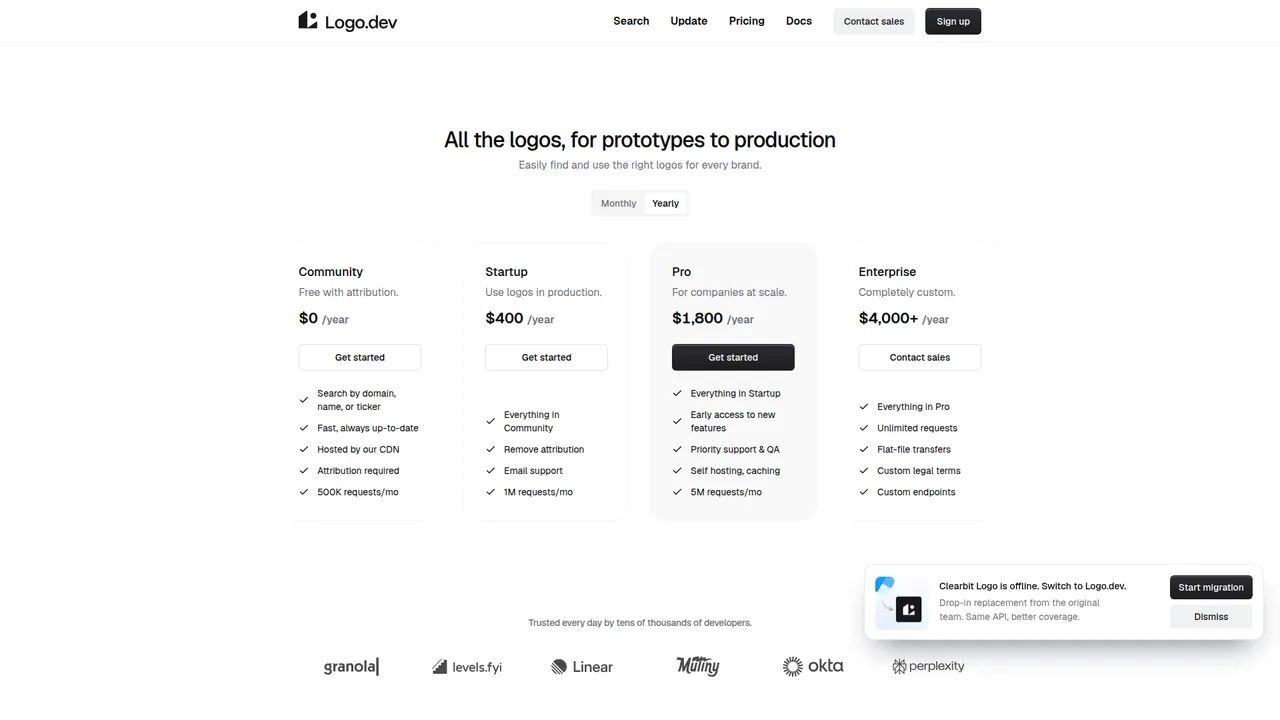
| NinjaPear | $0 forever | 300 requests/minute | ~12,960,000/month | Not required | PNG logo from domain | Public page says 300 req/min, no monthly fees, no attribution |
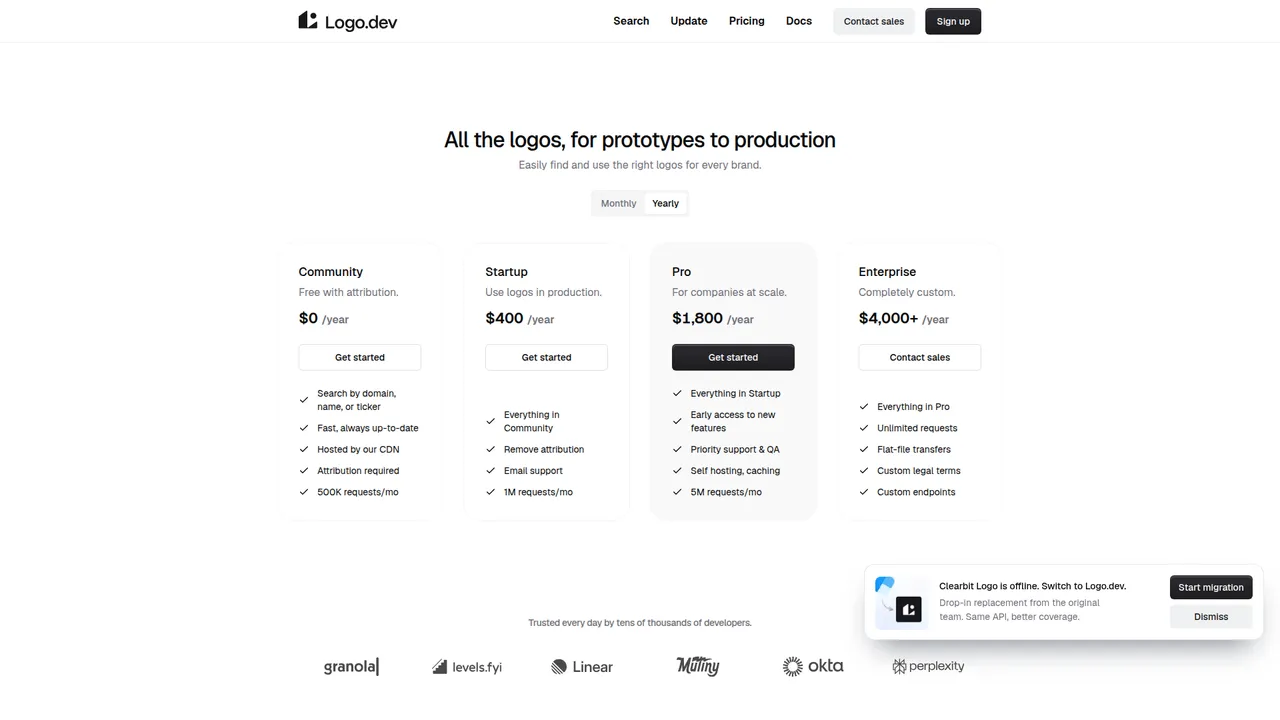
| Logo.dev Community | $0/year | 500,000 requests/month | 500,000/month | Required | Logo API with stronger frontend controls | Good free tier if attribution is acceptable |
| Logo.dev Startup | $400/year | 1M requests/month | 1,000,000/month | Removed | Paid production tier | Public pricing checked during research |
| Logo.dev Pro | $1,800/year | 5M requests/month | 5,000,000/month | Removed | Higher-volume paid tier | Public pricing checked during research |
| Brandfetch Logo API | Free forever | 500,000/month fair use soft limit | 500,000/month soft limit | No public attribution requirement on logo page | Free logo embedding | Burst limits documented separately |
| Brandfetch throughput | Included | 1,000 requests / 5 min / IP, 2,400 requests / 5 min / customer | Depends on traffic shape | N/A | Logo API docs | 429s after that |
| Clearbit | Retired | None worth planning around | 0 | N/A | Dead endpoint | Do not build on it |
That NinjaPear number is worth calling out. 300 req/min works out to ~12.96M requests/month if you annualize it over a 30-day month. That is above Logo.dev’s public 500K, 1M, and 5M caps.
That does not mean a per-minute limit is the same thing as a contractual monthly allowance. It isn’t. But if you want a clean contrast, that contrast is real.
A note on Logo.dev pricing: the brief referenced $280/year for Startup and $1,260/year for Pro. The public pricing page I checked showed $400/year and $1,800/year on annual billing. I’m using the live public numbers.
What those limits mean in production
Docs are one thing. Production is another.
- If you are building an internal tool, CRM, admin dashboard, notifications UI, or account list, NinjaPear’s free posture is hard to beat.
- If attribution is unacceptable in your UI, Logo.dev’s free tier stops being free in any meaningful sense.
- If your use case is simple and you still buy a richer asset platform, that is usually waste.
- Brandfetch is strong, but once you care about fonts, symbols, icons, and colors, you are solving a broader brand-data problem, not just a logo problem.
That distinction matters.
Is there a reason you cant download the images, put them in your site, and link directly? What value is the complication of an API adding?
That comment gets at the real question. If your logo set is small and stable, you may not need an API at all. If the list changes dynamically, you probably do.
Why Clearbit’s shutdown changed this category
Clearbit is the reason this category stopped being a toy.
A logo API seems trivial until it spreads across your product. One engineer adds it to onboarding. Then sales wants it in the CRM. Then support wants it in inbox rows. Then product adds it to alerts. Suddenly the “small utility” is real infrastructure.
A logo API is trivial until it becomes infrastructure
I have seen this more than once.
It starts with an <img> tag. It ends with a migration ticket nobody planned for.
That is why the buying question is not “which demo looks best?” It is “which provider solves the boring problem cleanly without becoming work later?”
The screenshot every buyer should see
Here is the screenshot every buyer should look at before picking a free provider.
And here is the line that matters:
“After December 1, 2025,
logo.clearbit.comstops working permanently.”
That sentence explains the trust problem in this category.
If you had Clearbit wired into your product, the shutdown was not a theory. It was work.
UPDATE: As of June 2024, Clearbit isn't allowing new users for the logo API. For anyone else looking to use a high-quality and free company logo and brand API at Logo.dev.
That was the opening for Logo.dev. Fair enough. It also does not mean everybody needs the paid tiers.
NinjaPear review: the free default I’d start with
I lead GTM at NinjaPear, so I’m not pretending to be neutral here. I am trying to be useful.
What I like
NinjaPear’s company logo API does the core job most buyers need: domain in, logo out.
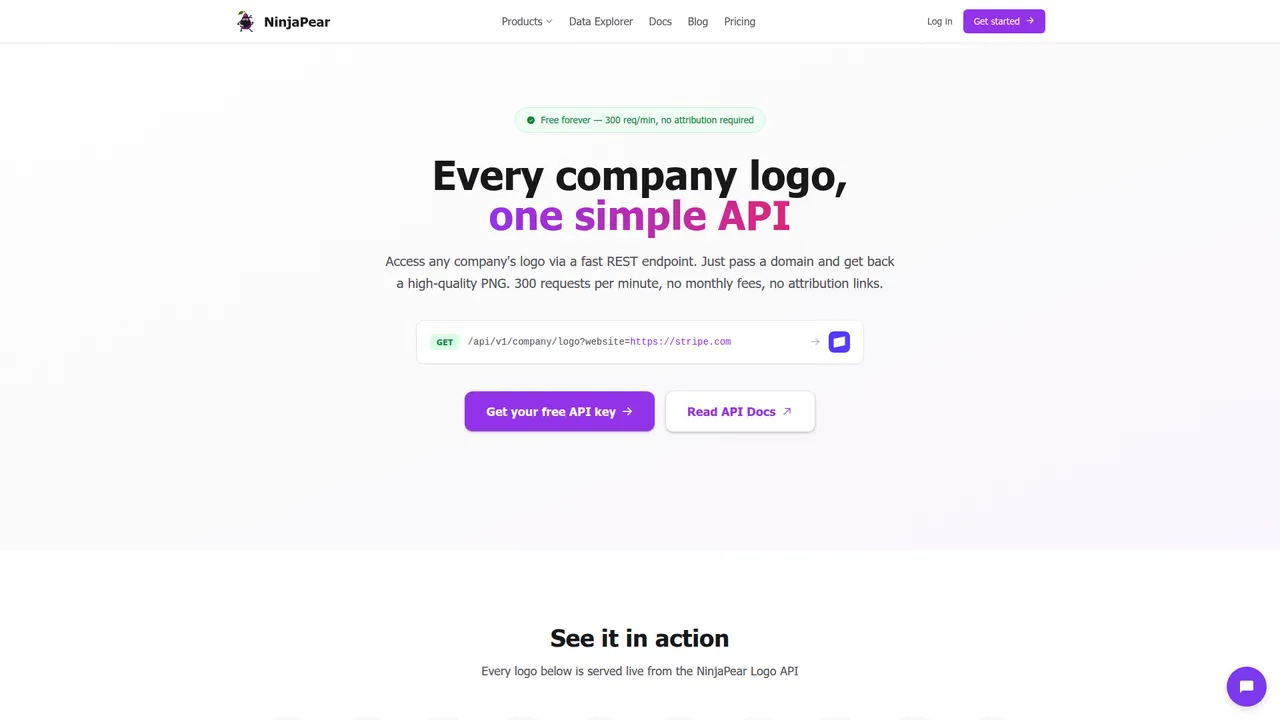
The public page is simple:
- Free forever
- 300 requests per minute
- ~12.96M requests/month equivalent if you annualize that rate
- No monthly fee
- No attribution required
- PNG output
That is good product scope. It stays in its lane.
The request shape is simple too:
curl -X GET \
  "https://nubela.co/api/v1/company/logo?website=https://stripe.com" \
  -H "Authorization: Bearer YOUR_API_KEY" \
  --output stripe-logo.png
You can wire that into an app in a few minutes.
What I don’t like
It is not a rich brand asset platform.
If you need SVG, multiple themes, symbols, or deeper asset control, this is not that. It is a blunt tool. That is fine. Most people searching for a company logo api need a blunt tool.
Best for
- Internal tools
- CRM enrichment
- Startup dashboards
- Notification and inbox UIs
- MVPs where shipping matters more than visual polish
My take
If your use case is boring, NinjaPear is better because it stays boring.
That is not a backhanded compliment. In infrastructure, boring is often the whole point.
Logo.dev review: good product, often unnecessary spend
I like Logo.dev. I also think plenty of buyers are paying for controls they never actually use.
What I like
Logo.dev has a clear product story. It also has the cleanest post-Clearbit migration angle.
The public pricing and docs make the pitch clear:
- SVG support
- dark mode and theme options
- retina and size controls
- ticker and brand search products
- cleaner frontend ergonomics for customer-facing apps
If your frontend team cares about rendering details, that has value.
What I don’t like
The free plan requires attribution.
That matters more than people admit. If I have to add your attribution to my public UI to keep free access, that is not free in the way most product teams mean free. It is a trade.
Pricing is also reasonable for a paid tool. But a lot of teams are still solving a $0 problem with a $400 or $1,800 answer.
Best for
- Teams moving off Clearbit
- Customer-facing SaaS where SVG or theme control really matters
- Products where presentation quality is part of the product value
My take
Logo.dev is good. I just think a lot of teams buying it are buying polish first and asking whether they need it second.
Brandfetch review: richer than most buyers need
Brandfetch is not really “just another logo API”. That is the key thing to understand.
What I like
Brandfetch is better when logos are one part of a bigger job.
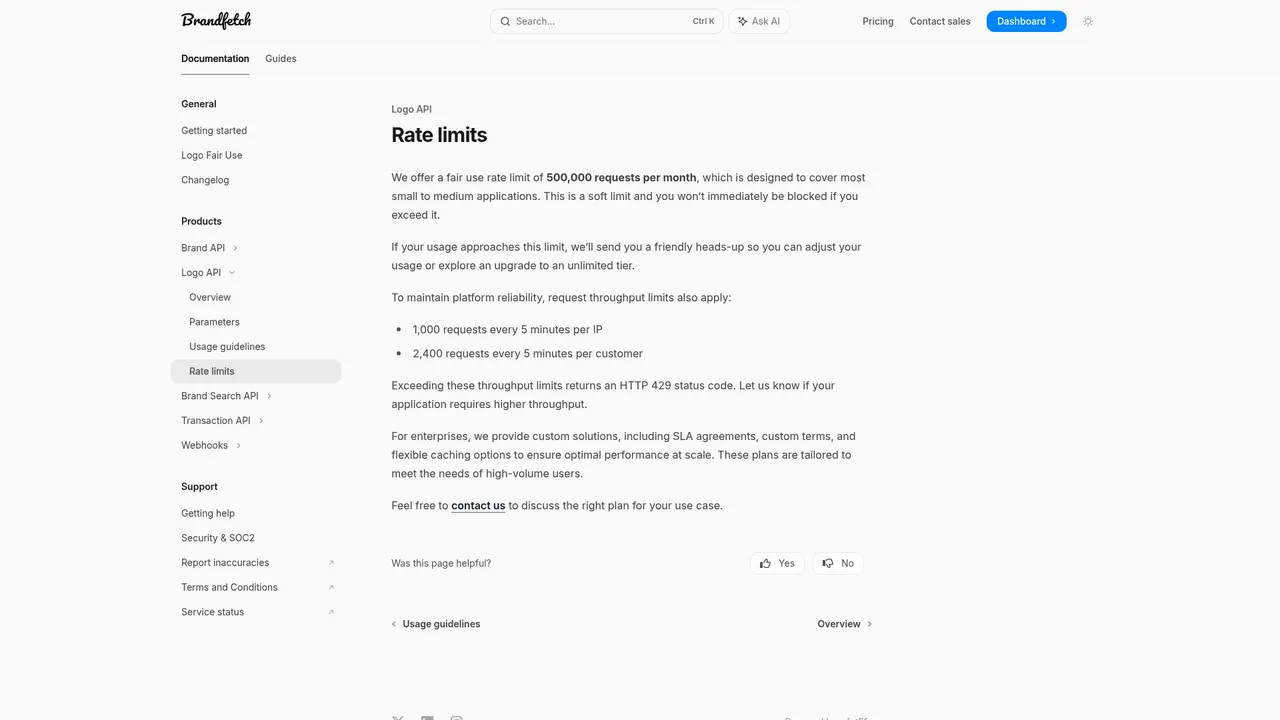
Their public positioning around the Logo API is straightforward, and the docs publish useful limits:
- 500,000 requests/month as a fair-use soft limit
- 1,000 requests every 5 minutes per IP
- 2,400 requests every 5 minutes per customer
That level of specificity helps.
What I don’t like
The deeper you go, the clearer it becomes this is a broader brand-data product.
That is good if you need it. It is overkill if all you need is a logo next to a company name.
Best for
- Fintech transaction enrichment
- Brand-aware UIs
- Products where icons, colors, fonts, and symbols are part of the actual UX
My take
If all you need is a logo, Brandfetch can be more product than problem.
Step 2: Create a free account on https://developers.brandfetch.com/ Step 3: Go to ... copy the code
That is a decent signal for the use case where someone wants bulk brand assets, not just one logo on an account row.
The buying criteria most pages skip
This is the part that actually matters.
Attribution is not a footnote
For some teams, attribution is fine.
For other teams, it is product debt. If you are building customer-facing software and care about a clean UI, “free with attribution” is a different kind of bill.
Monthly caps vs burst throughput
People mix these up constantly.
- Monthly caps matter for dashboards, account lists, and repeated product usage.
- Burst limits matter for imports, backfills, and jobs that spike.
NinjaPear publishes 300 req/min. That is ~12.96M requests/month if you convert it to a 30-day equivalent. Brandfetch publishes 500K/month fair use and burst limits. Logo.dev is framed around 500K, 1M, and 5M monthly caps.
Those are not the same constraints.
Caching policy is half the product
Before you integrate anything, ask:
- Can I cache locally?
- For how long?
- What happens if pricing changes?
- What happens if the endpoint disappears?
- How painful is migration?
People treat caching as legal fine print. It is not. It changes the whole cost shape.
Migration risk is real
Clearbit proved this already.
A tiny endpoint gets embedded into the product before anyone notices. Then it disappears, and suddenly five teams care.
Hands-on benchmark plan
I am not going to fake a giant benchmark. If I did not run it, I am not going to pretend I did.
What I can give you is a benchmark plan that an engineer can run in an afternoon.
25-domain benchmark
Use this list:
| # | Domain | Category |
|---|---|---|
| 1 | stripe.com | Fintech / SaaS |
| 2 | shopify.com | SaaS |
| 3 | figma.com | SaaS |
| 4 | notion.so | SaaS |
| 5 | slack.com | SaaS |
| 6 | zoom.us | SaaS |
| 7 | openai.com | AI |
| 8 | anthropic.com | AI |
| 9 | rippling.com | HR tech |
| 10 | brex.com | Fintech |
| 11 | ramp.com | Fintech |
| 12 | plaid.com | Fintech |
| 13 | mercury.com | Fintech |
| 14 | canva.com | Design |
| 15 | miro.com | SaaS |
| 16 | datadog.com | Public tech |
| 17 | snowflake.com | Public tech |
| 18 | cloudflare.com | Public tech |
| 19 | nike.com | Consumer |
| 20 | samsung.com | Consumer electronics |
| 21 | toyota.com | Enterprise / public |
| 22 | perplexity.ai | AI |
| 23 | linear.app | Startup |
| 24 | granola.ai | Startup |
| 25 | levels.fyi | Edge case brand / text-heavy logo |
For each provider, record:
- success or failure
- output format
- visible correctness
- fallback quality
- implementation friction
- cacheability
- rate-limit behavior under concurrency
Side-by-side output gallery
Test these 8 domains first:
- stripe.com
- shopify.com
- figma.com
- notion.so
- brex.com
- ramp.com
- granola.ai
- levels.fyi
Then compare:
- Does the logo render?
- Is it correct?
- Is the fallback usable?
- Does the endpoint need auth, attribution, or extra parameters to look good?
Your eyes will usually settle arguments faster than the landing pages will.
Real implementation snippets
NinjaPear
curl -X GET \
  "https://nubela.co/api/v1/company/logo?website=https://stripe.com" \
  -H "Authorization: Bearer YOUR_API_KEY" \
  --output stripe-logo.png
Logo.dev
<img src="https://img.logo.dev/stripe.com?token=YOUR_PUBLIC_TOKEN&size=128" alt="Stripe logo" />
If you are moving off Clearbit-style URLs, that is part of the appeal.
Brandfetch
curl -X GET \
  "https://cdn.brandfetch.io/stripe.com" \
  -H "Authorization: Bearer YOUR_API_KEY"
If you are seriously evaluating Brandfetch, do not stop at the logo endpoint. Test the broader brand attributes too. That is where the value either shows up or doesn’t.
Cost scenarios
| Monthly requests | NinjaPear | Logo.dev Community | Logo.dev Startup | Logo.dev Pro | Brandfetch Logo API |
|---|---|---|---|---|---|
| 100K | $0 | $0 with attribution | $400/year overkill | $1,800/year absurd | $0 under fair use |
| 500K | $0 | $0 with attribution | $400/year optional | $1,800/year overkill | $0 under fair use |
| 1M | $0, if 300 req/min fits your traffic shape | Over cap | $400/year | $1,800/year unless you need extras | Likely needs traffic-shape review |
| 5M | $0, if request pattern and caching make sense | Over cap | Over cap | $1,800/year | Likely enterprise discussion |
| ~12.96M equivalent | $0 at published 300 req/min throughput | Over cap | Over cap | Over cap | Over fair-use positioning |
This is where overbuying becomes obvious.
Who should use what in 2026
This is simpler than people make it.
Use NinjaPear if...
- You want the cheapest sane answer
- You just need
domain -> logo - PNG is enough
- You do not want attribution clutter
- You are building internal tools, CRMs, alerts, dashboards, or MVPs
Use Logo.dev if...
- You need SVG or theme-aware rendering
- You want the easiest Clearbit replacement path
- Your product team really cares about presentation details
- Those details are actual requirements, not just nice-to-haves
Use Brandfetch if...
- You want brand colors, fonts, symbols, icons, or richer brand context
- Your product is more brand surface than utility surface
- You are doing transaction enrichment or brand-aware UX
Do not overbuy this category
Most teams are overthinking this.
If you need a logo next to a company name, stop shopping like you are licensing a design system. Use the free option that solves the boring problem cleanly. Pay only when your product really needs the extra control.
A practical next step is simple: run the 25-domain benchmark, decide your attribution tolerance, decide your caching plan, and write down what happens if the provider disappears. That hour of work is more useful than another two days of reading landing pages.
A practical workbook with a vendor scoring sheet, 25-domain benchmark template, Clearbit migration checklist, and an internal buying memo you can steal.
Download now →