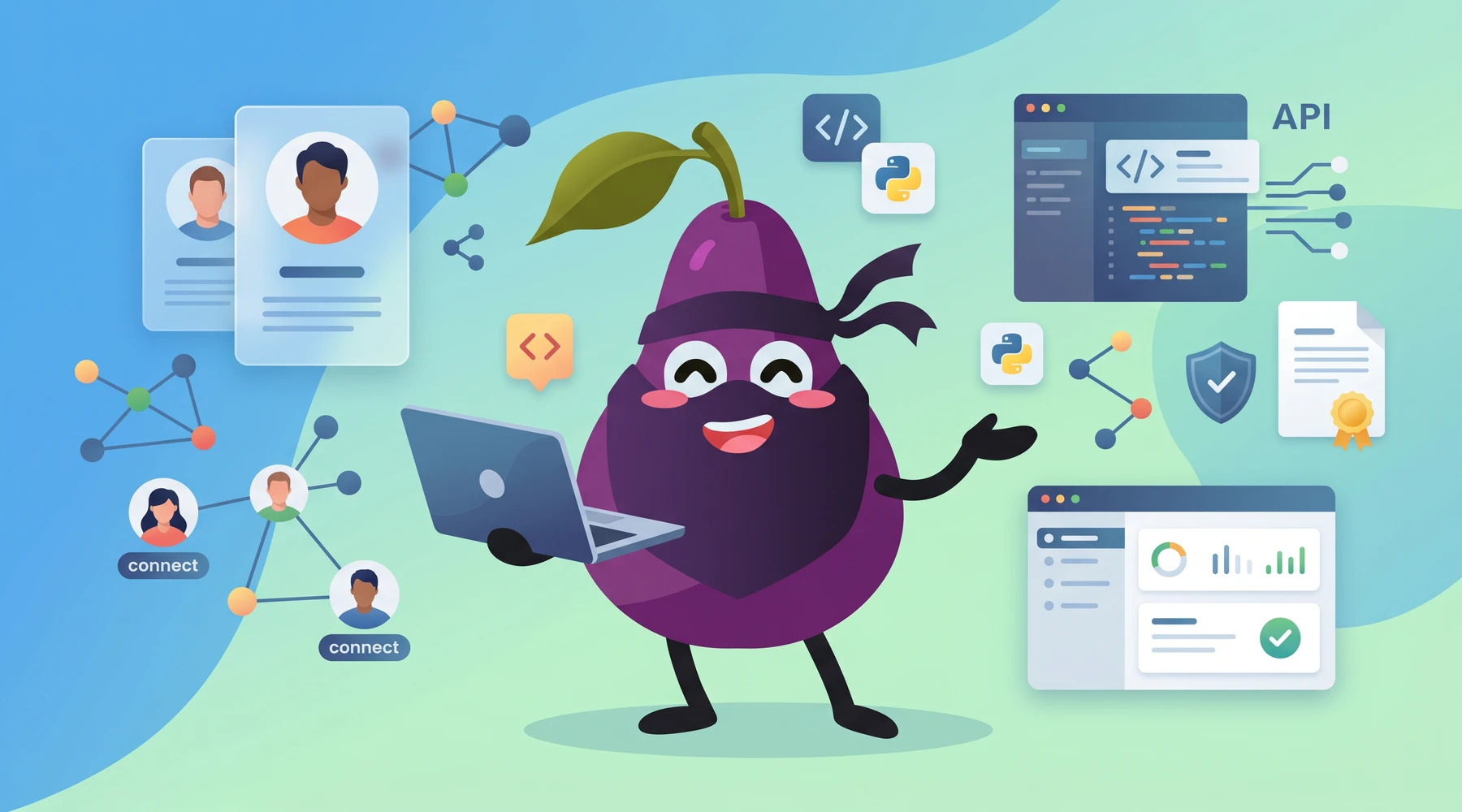
If you are building an AI agent that needs company data, in Claude, ChatGPT, Claude Code or your own stack, this piece is for you. If you want a scraping tutorial or a no-code sales tool, it is not.
Here is what your agent can plug into with NinjaPear:
| Your agent wants to know | It gets | NinjaPear tool |
|---|---|---|
| Which companies match my filter | A list of companies by query, country and headcount | Company Search API |
| How big is this company and what does it do | Size, description, HQ, executives | Company API |
| Who runs it | Named founders and C-suite | Company API |
| How much has it raised | Funding rounds and investors | Funding tools |
| Who buys from it and who it fights | Customer and competitor lists | Customers and competitors tools |
| Who to contact there | People by company and role | Employee Search API |
| How to reach them | Verified work email addresses | Work Email API |
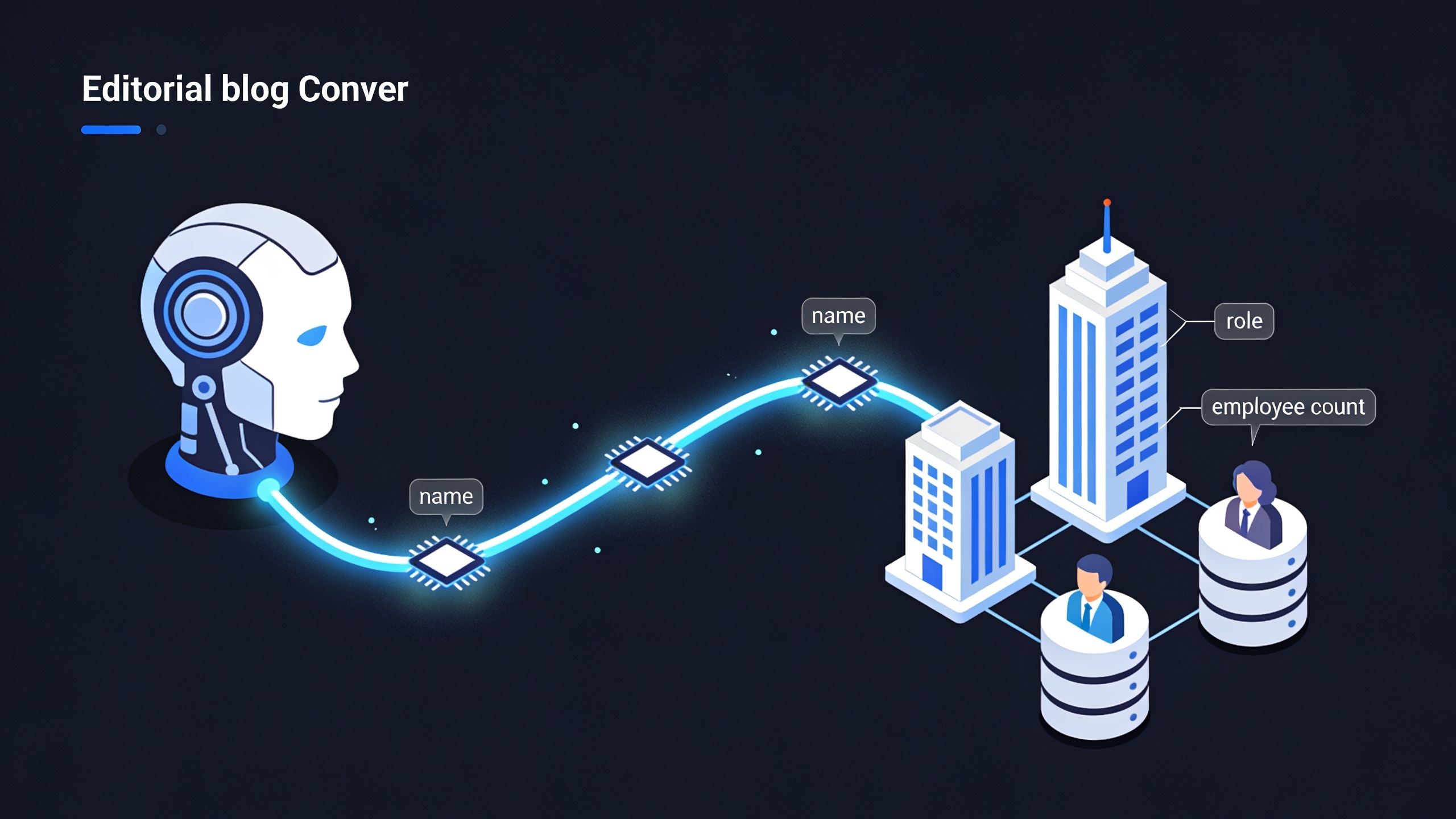
Chained together, that takes your agent from "which US payments startups have 50 to 500 staff" to "here is the founder's email" without leaving the conversation. What you need is a data source your agent can call without guessing how to ask, because a question asked the wrong way returns garbage the agent will happily use as if it were fact.
Once I fixed the parameter, the results became precise. Through NinjaPear's Company API I asked for stripe.com and immediately got a privately held company with 8500 employees based at 354 Oyster Point Boulevard in South San Francisco. It listed Patrick Collison, John Collison, and Will Gaybrick as the top executives. I then ran a search through the Company Search API for US payments infrastructure companies with 50 to 500 employees. This time, the agent pulled back a clean list: edfapay, Finix Payments, Agave Pay Inc., Silicon Valley Skyline LLP, and Preston Todd Advisors.
This is what a dedicated MCP server for B2B data buys you. Instead of building middleware or scraping the web, you give your agent a direct line to company and people data. The setup is a single URL, nubela.co/mcp, which works as a custom connector in Claude or ChatGPT and as a one-liner in Claude Code. With 29 tools available, your agent can move from a vague question to a verified list of executives and headquarters in seconds. I spent the afternoon testing the limits of these tools, and the result is a direct bridge between an LLM and real-world company intelligence.
What a B2B data MCP server is
I spent 22 November 2026 testing how AI agents handle company data. A B2B data MCP server gives your agent company and people data as tools it can call directly, with no custom integration code in between. Any agent that supports MCP can pull live business data immediately. This includes Claude, ChatGPT, Claude Code, Codex, and OpenCode.
I noticed that many teams use a gateway pattern to manage this. They set up one central MCP server that any model can connect to. This approach was discussed in an r/AI_Agents thread from 6 Sep 2026. The data for these tools comes from public web sources. NinjaPear does not scrape LinkedIn.
What the tools return in practice
I connected my agent to a single URL and ran two different calls to see the data in action. The first call pulled detailed information for a specific company.
| Parameter | Value |
|---|---|
| tool | ninjapear_get_company_details |
| website | stripe.com |
| include_employee_count | true |
| Field | Value |
|---|---|
| company_type | PRIVATELY_HELD |
| employee_count | 8500 |
| HQ line1 | 354 Oyster Point Boulevard |
| city | South San Francisco |
| state | CA |
| country | USA |
| description | Stripe is a financial services platform that helps all types of businesses accept payments, build flexible billing models and manage money movement. |
The response also returned a list of executives. This included Patrick Collison (Co-founder and Chief Executive Officer), John Collison (Co-founder and President), and Will Gaybrick (President, Technology and Business).
Next, I tested a search for a specific niche of businesses.
| Parameter | Value |
|---|---|
| tool | ninjapear_search_companies |
| query | payments infrastructure |
| country | US |
| employee_count | 50-500 |
| page_size | 5 |
| # | Company | Website |
|---|---|---|
| 1 | edfapay | https://edfapay.com/home/ |
| 2 | Finix Payments | http://www.finixpayments.com |
| 3 | Agave Pay, Inc. | https://agavepay.com |
| 4 | Silicon Valley Skyline, LLP | http://www.svskyline.com |
| 5 | Preston Todd Advisors | http://www.prestontoddadvisors.com |
For agents that speak JSON, here is the second call exactly as it went over the wire:
{
  "tool": "ninjapear_search_companies",
  "arguments": {
    "query": "payments infrastructure",
    "country": "US",
    "employee_count": "50-500",
    "page_size": 5
  }
}
This search call cost 2 credits to execute.
How to connect it
I hooked it up to Claude first. I went into Settings, then Connectors. From there, I added a custom connector and pasted nubela.co/mcp. ChatGPT followed the same flow. I navigated to its connector settings and created a custom connector with that same URL. Claude Code was even faster since it took just one line of setup. Codex and OpenCode required a small config block.
I also tried a separate package for coding agents. I ran npx skills add NinjaPear/ninjapear-skill. This teaches the coding agent to write the integration code correctly. It is not the same as the MCP server which focuses on querying data. To get the agents reading their own manual, I pointed them to the docs at nubela.co/llms-full.txt and llms.txt. There is also an OpenAPI 3.0 spec for better precision.
Why an MCP tool beats web search for an agent
A web search is often too noisy for an agent. It returns pages that the agent must read and then interpret. An MCP tool replaces that noise with structured rows. This means the agent can use the data immediately.
I saw this clearly when I looked for Stripe's headcount. A web search returned various articles with conflicting numbers and dates. The tool, however, returned a single number: 8500. It included a defined unit and the exact retrieval date.
Growth teams on Reddit are moving in this direction. In a r/GrowthHacking post from 10 August 2026, users discussed building B2B lead databases using AI and MCPs. They outlined a pipeline that goes from discovery to enrichment, verification, scoring, and then the CRM. In that architecture, an MCP is brought in once multiple systems need contextual access to the company data.
What the 29 tools cover
The server exposes 29 tools covering every endpoint plus feed management. I grouped them by what they return.
| Tool group | What it returns | Credits |
|---|---|---|
| company API | Company details by website (cached) | 3 |
| Company Search API | Companies filtered by query, country, or size | 2 |
| Employee Count API | Current company headcount | - |
| Work Email API | Work email lookups | 2 (hit) / 0.5 (miss) |
| Funding & Investors | Funding rounds and investor lists | - |
| Executives | Named company leadership | - |
| Customers | Known customer lists | - |
| Competitors | Identified company competitors | - |
| Products & Pricing | Current products and pricing data | - |
| Company Updates | Recent news and updates | - |
| Person Search | People filtered by company and role | 2 base + 1 per person |
| Person Profiles | Detailed individual profiles | 3 |
| Feed Management | Tools for monitoring company updates | - |
What it costs
Credits translate roughly to 1 cent each. Company details cost 3 credits while company search and person search start at 2 credits. For person search, I pay an extra credit for every employee returned. Work emails cost 2 credits on a hit but only 0.5 on a miss.
NinjaPear does not scrape LinkedIn. Data is compiled from public web sources.
If you want to dive deeper into the specific endpoints, I recommend the company search API guide, the people search API guide, and the enrichment tools comparison.